Insulation: which measures suit your house, and what they cost to fit
Insulation is the one upgrade that makes every other upgrade work better. What you can fit is decided by how the house was built — the walls, the roof and the floor each have their own answer.
We'll tell you whether it suits your property before anyone tries to sell you one.
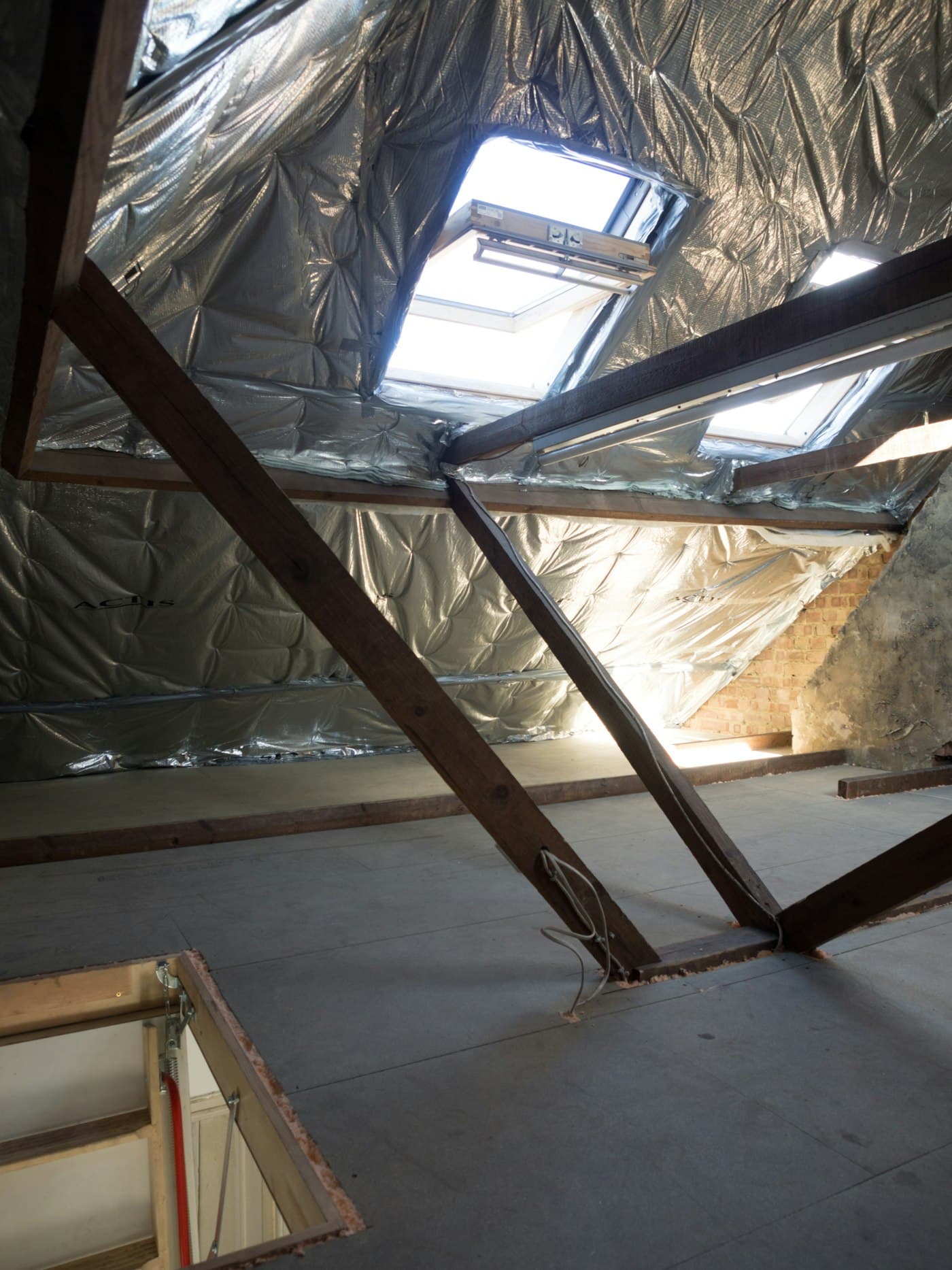
Loft top-up
£400–£900
Bringing an accessible loft to current depth
Cavity walls
£800–£2,500
Where the cavity is clear and wide enough
Solid walls
£8,000–£25,000
Internal or external, whole house
Draught-proofing
£200–£600
The cheapest measure in most homes
Illustrative. Placeholder figures to show what this page will hold. Real ranges arrive with the quote and performance data behind them.
The short answer
Draught-proofing and a loft top-up are the cheapest heat any home will ever buy, and they make every later upgrade smaller. Solid wall insulation is the exception: it costs as much as a heat pump and takes decades to repay on bills alone.
We don't sell insulation, and no installer pays to appear here. If the answer for your home is no, the page will say so.
Usually worth it if
- Loft with thin 1980s insulation and easy hatch access
- Clear cavity walls in a house built after 1930
- Draughty period home with gaps around doors and floorboards
Probably not yet if
- Post-1995 house with the cavity already filled
- Exposed wall where driving rain rules out cavity fill
- Solid walls while the loft is still bare
Costs
What it costs
Insulation prices turn on access and area more than on the material. A clear loft hatch and an empty cavity are cheap; a crowded loft, a room in the roof or a solid wall are not. What each measure saves depends on the heat the house loses now, which needs a survey rather than a table, so only the cost is here.
Loft insulation, topped up to current depth
Installed cost
£400–£900
Cavity wall insulation, 3-bed semi
Installed cost
£800–£2,500
Solid wall insulation, internal, whole house
Installed cost
£8,000–£18,000
Suspended timber floor insulation
Installed cost
£1,500–£4,000
Illustrative. Placeholder figures to show what this page will hold. Real ranges arrive with the quote and performance data behind them.
The homes
What the certificates say about insulation
Every energy certificate in England and Wales records what the assessor found and lists what would raise the rating. Counted up, they show how many homes are still waiting for this.
Cavity walls still empty
25.9%
Of cavity-walled homes, empty or partly filled
Solid walls uninsulated
90.4%
Of solid-walled homes
Lofts under 100 mm
22.1%
Of homes with a loft
Walls
Share of homes in England and Wales, as the certificate found it.
- Cavity, filled40.9%
- Cavity, partly filled2.2%
- Cavity, empty12.1%
- Solid, insulated2.4%
- Solid, uninsulated22.1%
- Built to a modern standard13.7%
- Timber, system built or other6.6%
An assessor takes a cavity as empty unless there is evidence it was filled, so some counted as empty will have been.
Roofs and lofts
Share of homes in England and Wales, as the certificate found it.
- Loft, no insulation8.1%
- Loft, under 100 mm6.8%
- Loft, 100 to 199 mm17.9%
- Loft, 200 mm or more29.6%
- Loft, depth not recorded5%
- Flat roof, roof rooms or thatch4.3%
- Built to a modern standard10.4%
- Another home above17.8%
Current guidance is 270 mm in a loft.
| Measure | Recommended to | The EPC method's cost |
|---|---|---|
| Cavity wall insulation | 16.1% of homes | £900–£1,500 |
| Loft insulation | 12% of homes | £900–£1,200 |
| Solid wall insulation | 24% of homes | £7,500–£11,000 |
| Floor insulation | 49.5% of homes | £5,000–£10,000 |
| Room-in-roof insulation | 3.1% of homes | £900–£1,200 |
| Flat roof insulation | 4.3% of homes | £900–£1,200 |
From the EPC register to 9 September 2026, each home's latest certificate, England and Wales. A certificate recommends what would raise its rating, by the rules of the year it was lodged. The method's cost is the range the middle recommendation was given, the same for every home: a guide, not a quote.
Grants
What you can claim, nation by nation
Insulation is the measure most often covered by grants, but eligibility usually depends on income, benefits, EPC band and sometimes council tax band rather than on the house alone. We will show which schemes apply at your address, the date the rules were last checked, and a link to the source.
England and Wales
- ECO4
- Great British Insulation Scheme
- Local authority delivery schemes
ECO4 is supplier-funded and aimed at low-income households, and usually treats the home as a whole rather than fitting one measure in isolation. The Great British Insulation Scheme is broader and can cover a single measure such as cavity or loft insulation. Councils also run their own schemes with their own criteria.
Scotland
- Warmer Homes Scotland
- Home Energy Scotland grant and loan
- ECO4
Warmer Homes Scotland covers households in fuel poverty, and Home Energy Scotland offers a grant with an interest-free loan for owner-occupiers paying for work themselves. ECO4 runs here too, through the energy suppliers.
Northern Ireland
- Affordable Warmth Scheme
- NI Sustainable Energy Programme
Support is delivered through councils and the Housing Executive rather than the GB schemes, and is targeted at lower-income households. The Great British Insulation Scheme does not apply in Northern Ireland.
Scheme rules change. Each one will carry the date we last checked it against Ofgem and GOV.UK.
Your property
Will it suit your home?
The answer turns on how your home was built, not on what the product can do in a brochure.
The age of the house decides most of it
Homes built before about 1920 usually have solid walls and need a different, more expensive answer than the cavity walls of the decades after. Anything built since the mid-1990s is likely to have insulation in the cavity already.
Cavity walls are not always suitable
A cavity can be too narrow, already filled, blocked with mortar, or in a wall so exposed to driving rain that filling it risks moisture crossing to the inside. A borescope survey settles it before anyone quotes.
Solid walls: inside or outside
External insulation keeps your rooms the size they are but changes the look of the house and needs scaffolding. Internal insulation is cheaper per wall but means stripping rooms back, moving sockets and radiators, and losing a little floor area.
Ventilation has to keep up
Sealing a house without giving moisture a way out moves condensation and mould to the coldest surface left. Extract fans, trickle vents and, in some retrofits, mechanical ventilation are part of the job, not an extra.
Lofts, floors and the easy wins first
Draught-proofing and loft insulation are the cheapest measures per pound saved in most homes. Underfloor insulation only applies where there is a suspended timber floor with a void beneath it, not a concrete slab.
Non-standard construction
Park homes, timber frame, steel frame, system-built concrete and stone cottages each need a specific approach, and some of the standard products are not appropriate. These homes are also the ones where generic advice goes most wrong.
In progress
What lands on this page next
Some of this page is built from published data now. Still to come, in order:
- The likely wall construction for your property, from EPC and census-era building data
- Cost bands from real quotes, by measure, property type and region
- Which grant schemes you could qualify for at your address, and on what criteria
- Measured savings from insulated homes rather than modelled EPC estimates
- TrustMark-registered installers covering your postcode, with their registration history
- The order to do the work in, and which measures need ventilation work alongside
Where the answers come from
- EPC Register — recorded wall, roof and floor construction for your property
- Census and housing stock data — construction age and type by area
- TrustMark and CIGA — registered installers and guarantee records
- Ofgem and GOV.UK — ECO4 and Great British Insulation Scheme rules and current amounts
Questions
Common questions
How deep should loft insulation be?
Current guidance for a new installation is far deeper than the levels fitted in the 1970s and 1980s, so many lofts insulated decades ago are worth topping up. Depth matters less than coverage: gaps at the eaves, around the hatch and under stored boxes undo a lot of the benefit.
Can cavity wall insulation cause damp?
It can, where the wall is badly exposed, the cavity is bridged by mortar or debris, or the survey was cut short. Done on a suitable wall by a registered installer it should not. The risk is a reason to insist on a proper survey, not a reason to rule the measure out everywhere.
Is external or internal solid wall insulation better?
External generally performs better and avoids disrupting the rooms, but it costs more, needs scaffolding and changes the appearance, which matters in conservation areas. Internal is cheaper and can be done room by room, at the cost of living through the work and losing a little space.
What guarantee should insulation come with?
Cavity wall insulation is normally covered by a CIGA guarantee, and grant-funded work must be done by a TrustMark-registered business working to the PAS 2035 retrofit standard. Keep the certificate: it is what a future buyer's surveyor will ask for.
Is draught-proofing worth doing on its own?
Yes. It is usually the cheapest measure in the house and the one people notice most, because draughts affect how warm a room feels at a given temperature. Leave purpose-built vents, air bricks and flues alone when you seal.
Do I need insulation before a heat pump?
Not always, but reducing heat loss first means a smaller unit, a lower price and lower running costs. A heat loss survey will tell you which measures change the answer for your house and which make little difference.
Keep reading
Worth reading next
See whether insulation suit your home
Start with your postcode and we'll work from what is already known about the property.